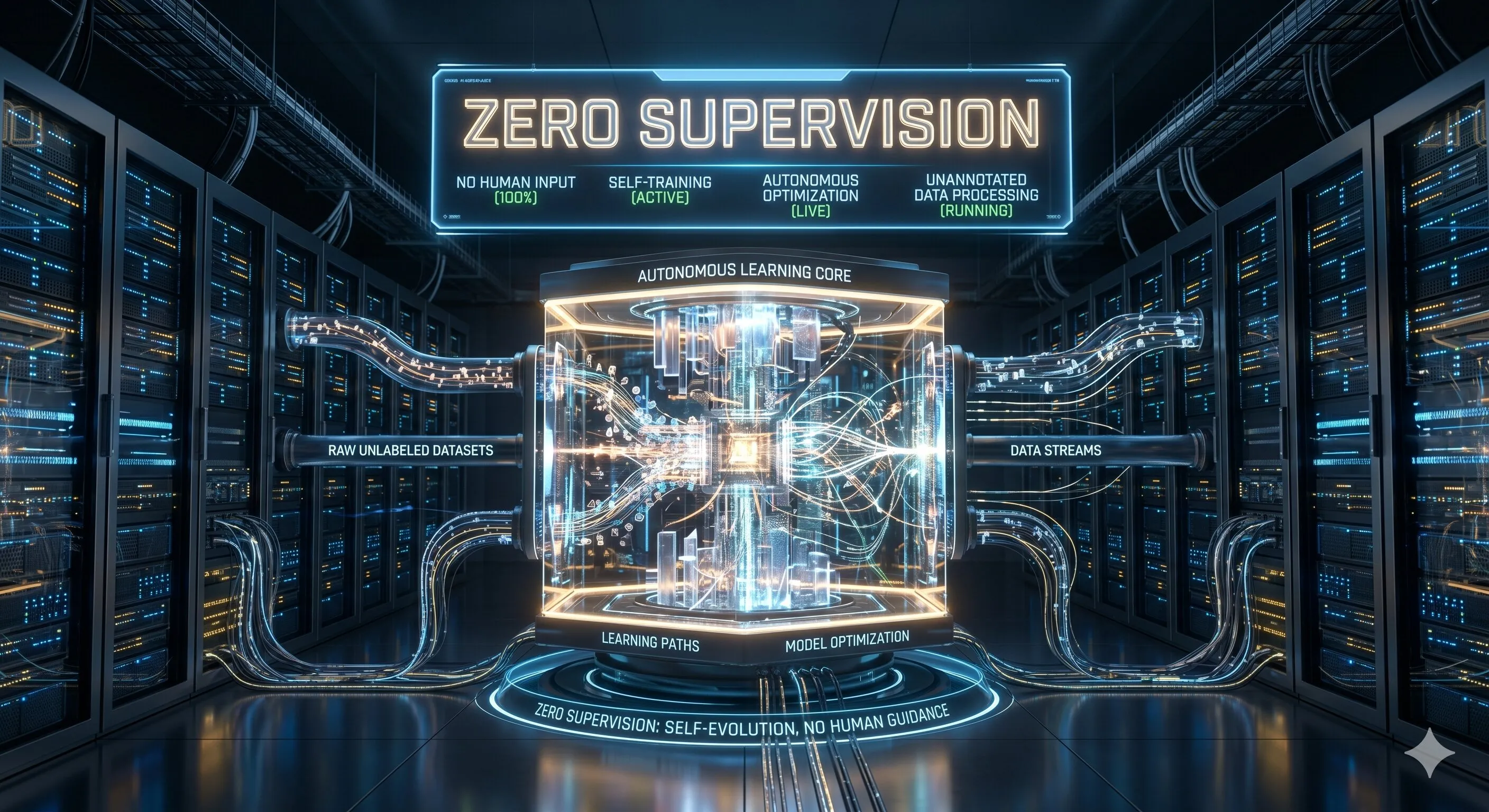
Zero Supervision
Zero supervision refers to AI models and systems that operate, train, or optimize themselves without needing human-annotated data or external guidance.
Zero Supervision#
Zero supervision refers to AI models and systems that operate, train, or optimize themselves without needing human-annotated data or external guidance.
Recent advancements (2025–2026) focus on inference-time self-evolution and self-generated rewards to achieve state-of-the-art (SOTA) results in coding, reasoning, and text correction.
Key Developments in Zero Supervision (2025–2026)#
1. MAS-Zero (Multi-Agent Systems)#
A framework that designs multi-agent systems at inference time through self-evolving meta-feedback.
- Achieves superior accuracy to manual approaches in coding and reasoning
- Does not require labeled training data
2. CEC-Zero (Character Error Correction)#
A zero-supervision reinforcement learning framework that allows large language models (LLMs) to correct errors in text by generating their own rewards.
- Outperforms supervised models by 10–13 F1 points
3. RLZero (Robot Learning)#
Enables zero-shot language-to-behavior policies by “imagining” tasks and grounding them in video-language models.
- Removes the need for supervised robot training
4. Absolute Zero (Reasoning)#
A paradigm (AZR) where agents propose and solve their own tasks to maximize learning.
- Achieves SOTA results in math and code
- Requires no external training data
5. AlphaMath “Almost Zero”#
Uses Monte Carlo Tree Search (MCTS) to generate self-supervised process rewards.
- Matches or exceeds GPT-4-supervised models in math reasoning
Advantages#
-
Cost Efficiency
Eliminates the need for expensive human labor to annotate data -
Scalability
Allows models to learn from raw, unlabeled web data or self-simulation -
Adaptivity
Enables models to adapt to new problems at inference time
Core Components#
-
Self-Generated Rewards
Models compute their own success metrics (e.g., semantic similarity, consensus) -
Self-Evolution
Iteratively improving a model based on its own past performance -
Code Execution Verification
Using tools to test and verify answers